Menu Close

That First Distribution from Your IRA

That First Distribution from Your IRA

What you need to know.

When you are in your seventies, Internal Revenue Service rules say that you must start making withdrawals from your traditional IRA(s). In I.R.S. terminology, these withdrawals are called Required Minimum Distributions (RMDs).1

Generally, these distributions from traditional IRAs must begin once you reach age 72. The money distributed to you is taxed as ordinary income. (When such distributions are taken before age 59½, they may be subject to a 10% federal income tax penalty.)1

If you fail to make these withdrawals or take out less than the required amount, the I.R.S. will notice. In addition to owing income taxes on the undistributed amount, you will owe 50% more. (This 50% penalty can be waived if you can show the I.R.S. that the shortfall resulted from a “reasonable error” instead of negligence.)1

Many owners of traditional IRAs have questions about these IRA distributions and the rules related to them, so let’s answer a few.

When is the deadline for your initial IRA distribution? It must be taken by April 1 of the year after the year in which you turn 72. So, if you turn 72 in 2020, your first distribution from your traditional IRA has to occur by April 1, 2021. All the distributions you take in subsequent years must be taken by December 31 of each year.1

The starting age for these distributions has changed from 70½ to 72 due to a new federal law, the Setting Up Every Community for Retirement Enhancement (SECURE) Act. IRA owners born on or after July 1, 1949 are now scheduled to take initial IRA distributions after they turn 72.2

Is waiting until April 1, 2021 a bad idea? Maybe. While the I.R.S. allows you three extra months to take that initial IRA distribution, putting off the withdrawal could bring on a tax issue. These distributions are taxable in the year that they are taken. If you postpone the initial distribution slated for 2020 into 2021, then the taxable portions of both your first mandatory IRA distribution (deadline: April 1, 2021) and your second mandatory IRA distribution (deadline: December 31, 2021) must be reported as income on your 1040 form for 2021.1

A hypothetical example: James and his wife Stephanie file jointly, and together they earn $168,400 in 2020 (the upper limit of the 22% federal tax bracket). James turns 72 in 2020, but he decides to put off his first IRA distribution until April 1, 2021, so that means he must take two IRA distributions before 2021 ends. His 2021 taxable income jumps as a result, and it pushes the pair into a higher tax bracket. The lesson: if you will be 72 by the time 2020 ends, take your initial distribution by the end of 2020 – or risk potentially higher taxes.1,3

How do I calculate my first IRA withdrawal? If your IRA is held at one of the big investment firms, it may calculate the withdrawal amount for you and offer to route the amount into another account of your choice. It will give you and the I.R.S. a 1099-R form recording the distribution, and the amount of it that is taxable.5

Otherwise, I.R.S. Publication 590 is your resource. You calculate the amount of the distribution using Publication 590’s life expectancy tables, and your IRA balance on December 31 of the previous year. If you Google “how to calculate your required IRA distribution,” you will see links to worksheets at irs.gov and a host of other free online calculators.1,4

If your spouse is more than 10 years younger than you and is designated as the sole beneficiary for a traditional IRA that you own, you should use the I.R.S. IRA Minimum Distribution Worksheet (downloadable as a PDF) to help calculate your distribution.6

Can I take my IRA distribution in increments? Yes, if time permits. Your IRA custodian may be able to schedule these incremental withdrawals for you, perhaps with taxes withheld.7

What if I have more than one traditional IRA? You can figure out the total mandatory distribution by separately calculating the distribution for each of your traditional IRAs. You can take the total distribution amount from a single traditional IRA or multiple traditional IRAs.1

What if I have a Roth IRA? You don’t need to make mandatory IRA withdrawals from a Roth IRA if you are its original owner. Only inherited Roth IRAs require these withdrawals.1

Be proactive. Delaying your first IRA distribution until 2021 could mean higher income taxes in 2022.

Citations
1 – irs.gov/retirement-plans/retirement-plans-faqs-regarding-required-minimum-distributions [2/7/20]
2 – forbes.com/sites/kristinmckenna/2020/01/10/you-can-now-take-required-minimum-distributions-at-72-but-should-you [1/10/20]
3 – nerdwallet.com/blog/taxes/federal-income-tax-brackets/ [2/5/20]
4 – google.com/search?client=firefox-b-1-d&q=how+to+calculate+your+required+IRA+distribution [2/10/20]
5 – finance.zacks.com/everyone-ira-1099r-4710.html [3/6/19]
6 – irs.gov/pub/irs-tege/jlls_rmd_worksheet.pdf [2/10/20]
7 – fidelity.com/viewpoints/retirement/smart-ira-withdrawal-strategies [1/27/20]


This material was prepared by MarketingPro, Inc., and does not necessarily represent the views of the presenting party, nor their affiliates. This information has been derived from sources believed to be accurate. Please note – investing involves risk, and past performance is no guarantee of future results. The publisher is not engaged in rendering legal, accounting or other professional services. If assistance is needed, the reader is advised to engage the services of a competent professional. This information should not be construed as investment, tax or legal advice and may not be relied on for the purpose of avoiding any Federal tax penalty. This is neither a solicitation nor recommendation to purchase or sell any investment or insurance product or service, and should not be relied upon as such. All indices are unmanaged and are not illustrative of any particular investment.


Are you Happy with Your Financial Adviser?

Are you Happy with Your Financial Adviser?

Have they met with you to discuss how recent market fluctuations could affect your financial plans? When was the last time the two of you sat down to really discuss goals?

It’s imperative to re-visit financial plans often to make sure they’re in line with changes in the market, your life, your financial situation and/or your goals. If you feel your current plan may be out of date, you’re not alone.

Maybe it’s time for a change.

I work with a select group of clients with whom I have built trusted personal relationships. My commitment to their financial well-being is strong. They know I’ll be there when they have questions or concerns. They know I’m available, knowledgeable, and proactive.

In today’s economy, a good financial professional should do more than merely “check-up” on a client every now and then. You need someone who will actively follow your investments, someone who listens when you tell your story, someone who provides leadership at the right time.

If you feel your portfolio could use a little more care and attention … please contact me. I can be reached at (215) 766-7002 or via email at bchavez@aeinvestmentsgroup.com.

I hope to hear from you soon.

Kind Regards,

Brent E Chavez
President, Aequitas Equitas Wealth Management
Investment Adviser Representative


Schedule A Consultation

Learn more: Why Choose AE?Our PhilosophyServices We Provide.

Tax Considerations for Retirees

Tax Considerations for Retirees

Are you aware of these potential tax breaks and tax-saving opportunities?

The federal government offers some major tax breaks for older Americans. Some of these perks deserve more publicity than they receive.

At age 65, the Internal Revenue Service gives you a larger standard deduction. For 2020, standard deductions look like this for taxpayers 65 and older: single filer or married filing separately, $14,050; head of household, $20,300; married filing jointly or qualifying widow(er), $26,100 (when one spouse is 65 or older) or $27,400 (when both spouses are 65 or older). The standard deductions for younger taxpayers range from $1,650-$2,600 less.1

There are two situations where your standard deduction may be limited at age 65 or older, or disappear entirely. One is when another taxpayer claims you as a dependent. The other is when you are married and filing separately, and your spouse itemizes deductions.1

You may be able to write off some medical costs. The I.R.S. will let you deduct qualifying medical expenses once they exceed 7.5% of your adjusted gross income (AGI). The list of eligible expenses is long. Beyond out-of-pocket costs paid to doctors and other health care professionals, it also includes things like insurance premiums for extended care coverage, travel costs linked to medical appointments, and payments for durable medical equipment, such as dentures and hearing aids.2

Are you thinking about selling your home? Many retirees consider this. If you have lived in your current residence for at least two of the five years preceding a sale, you can exclude as much as $250,000 in gains from federal taxation (a married couple can shield up to $500,000). These limits, established in 1997, have never been indexed to inflation. This exclusion is only allowed once every two years.3 

Low-income seniors may qualify for the Credit for the Elderly or Disabled. This incentive, intended for people 65 and older, can be as large as $7,500 based on your filing status. You must have very low AGI and nontaxable income to claim it, though. It is basically designed for those living wholly or mostly on Social Security benefits.4

Affluent IRA owners may want to make a charitable IRA gift. Generally, once you reach age 72, you must begin taking required minimum distributions (RMDs) from a traditional IRA. You may not be looking forward to these annual withdrawals, especially if you are well off. You have another option: you can make a Qualified Charitable Distribution (QCD) using those traditional IRA assets.5

You can donate up to $100,000 of traditional IRA assets to a qualified charity in a single year this way, and the amount donated counts toward your required withdrawal. The amount of the QCD is excluded from your gross income for the year of the donation. Eligibility to make a QCD still begins at 70½, even though the Setting Every Community Up for Retirement Enhancement (SECURE) Act raised the starting age for annual traditional IRA distributions from 70½ to 72.5

It must be mentioned that withdrawals from traditional IRAs are taxed as ordinary income (and, if taken before age 59½, may be subject to a 10% federal income tax penalty).

Of course, some states also give seniors tax breaks. For example, the following 11 states do not tax federal, state, or local pension income: Alabama, Hawaii, Illinois, Kansas, Louisiana, Massachusetts, Michigan, Mississippi, Missouri, New York, and Pennsylvania. Twenty-eight states (and the District of Columbia) refrain from taxing Social Security income.6

Unfortunately, your Social Security benefits could be partly or fully taxable. They could be taxed at both the federal and state level, depending on how much you earn and where you happen to live. Whether you feel this is reasonable or not, you may have the potential to claim some of the tax breaks mentioned above as you pursue the goal of tax efficiency.7

Questions? We offer Tax Planning services, as well as, full Financial Planning Packages. Contact us today: (215) 766-7002, info@aeinvestmentsgroup.com

Citations
1 – efile.com/tax-deduction/federal-standard-deduction/ [1/20/20]
2 – thebalance.com/deducting-medical-expenses-retirement-2894613 [11/4/19]
3 – investopedia.com/ask/answers/06/capitalgainhomesale.asp [2/16/20]
4 – thebalance.com/tax-breaks-for-seniors-and-retirees-4148392 [1/14/20]
5 – giving.princeton.edu/giftplanning/current-ira-gifts [2/18/20]
6 – thebalance.com/state-income-taxes-in-retirement-3193297 [7/15/19]
7 – smartasset.com/retirement/is-social-security-income-taxable [1/16/20]


This information is not intended to be a substitute for specific individualized tax advice. We suggest that you discuss your specific tax issues with a qualified tax adviser. This material was prepared by MarketingPro, Inc., and does not necessarily represent the views of the presenting party, nor their affiliates. This information has been derived from sources believed to be accurate. Please note – investing involves risk, and past performance is no guarantee of future results. The publisher is not engaged in rendering legal, accounting or other professional services. If assistance is needed, the reader is advised to engage the services of a competent professional. This information should not be construed as investment, tax or legal advice and may not be relied on for avoiding any Federal tax penalty. This is neither a solicitation nor recommendation to purchase or sell any investment or insurance product or service, and should not be relied upon as such. All indices are unmanaged and are not illustrative of any particular investment.

Retirement Is a Beginning

Retirement Is a Beginning

See if you are prepared to begin your retirement by answering four key questions.

How do you know you are psychologically ready to retire? As a start, ask yourself four questions.

One, is your work meaningful? If it is emotionally and psychologically fulfilling, if it gives you a strong sense of purpose and identity, there may be a voice inside your head telling you not to retire yet. You may want to listen to it.

It can be tempting to see retirement as a “finish line”: no more long workdays, long commutes, or stressful deadlines. But it is really a starting line: the start of a new phase of life. Ideally, you cross the “finish line” knowing what comes next, what will be important to you in the future.

Two, do you value work or leisure more at this point in your life? If the answer is leisure, score one for retirement. If the answer is work, maybe you need a new job or a new way of working rather than an exit from your company or your profession.

An old saying says that retirement feels like “six Saturdays and a Sunday.” Fantastic, right? It is, as long you don’t miss Monday through Friday. Some people really enjoy their careers; you may be one of them. 

Three, where do your friends come from? If very little of your social life involves the people you work with, then score another point for retirement. If your friends are mainly your coworkers, those friendships may be tested if you retire (and you may want to try to broaden your social circle for the future). 

At a glance, it might seem that an enjoyable retirement requires just two things: sufficient income and sufficient return on your investments. These factors certainly promote a nice retirement, but there are also other important factors: your physical health, your mental health, your relationships with family and friends, your travels and adventures, and your outlets to express your creativity. Building a life away from work is a plus.

Four, what do you think your retirement will be like? If you think it will be spectacularly different from your current life, ask yourself if your expectations are realistic. If after further consideration they seem unrealistic, you may want to keep working for a while until you are in a better financial position to try and realize them or until your expectations shift.

Ideally, you retire when you are financially, emotionally, and psychologically ready. The era of the “organization man” retiring with a gold watch and a party at 65 is gone; the cultural forces that encouraged people to stop working at a certain age aren’t as strong as they once were. 

Why you are retiring is as important as when you choose to retire. When you are motivated to retire, you see retirement as a beginning rather than an end.


Are you prepared for retirement? Will you have enough to retire?
Get your retirement plan in place. Schedule a FREE no-obligation initial consultation with us today:

Schedule A Consultation

Learn more about the Services We Provide, Our Process, and Brent E Chavez.


This material was prepared by MarketingPro, Inc., and does not necessarily represent the views of the presenting party, nor their affiliates. All information is believed to be from reliable sources; however we make no representation as to its completeness or accuracy. Please note – investing involves risk, and past performance is no guarantee of future results. The publisher is not engaged in rendering legal, accounting or other professional services. If assistance is needed, the reader is advised to engage the services of a competent professional. This information should not be construed as investment, tax or legal advice and may not be relied on for the purpose of avoiding any Federal tax penalty. This is neither a solicitation nor recommendation to purchase or sell any investment or insurance product or service, and should not be relied upon as such. All indices are unmanaged and are not illustrative of any particular investment.

Position & Market Update 2-27-2020

Video Transcript:

Hello everyone. Brent Chavez, Aequitas Equitas Investment Group. I hope this video finds you well. It is Thursday afternoon, and we are in the midst of a market crash that is somewhat unprecedented in it being a draw down in such a short period of time. I just wanted to give you a follow up and tell you again, where we stand, a follow-up to the two videos I sent you this last month of what we’re doing to protect your portfolios, has been working tremendously. But, I want to go a little bit deeper as to what we saw, what we’re seeing that made us do something that is very rare for us as a practice to go so defensive. As many of you know, it’s not something we like to do, those that have been with us for a long period of time. 

I’m going to share with you some things that we saw going on at the end of January that concerned us. As I mentioned in my video from January, we had had a big run up. We had stretch valuations in the markets. We were seeing a flight to bonds, globally, inflows to bonds were really up ticking. And as the yields were dropping, buyers would come in, grab those bonds. No matter how low those yields were, buyers were showing up. And at the same time seeing the deterioration of the many individual stocks in indexes in sectors globally that was a concern to us. We’re going to touch on again this is not going to be all encompassing of what we’re looking at for you on a daily, weekly, monthly basis, but just a little bit deeper than the last two videos have been. 

So again, back here in January, the S&P had hit a short term target that we had around 3300. We had noticed as we looked around, there were some canaries in the mines and red flags, so to speak. We’re going to take a look at them.

We see here some sideways action in the S&P 500. We saw it ticking up for a few weeks after we went defensive with all your portfolios, but we felt that that was more or less a “sucker’s rally,” as I like to call people being taken in before the fall off the cliff, potentially was going to take place. We’re here today as we do this video around 3000, a little over 3000. So again, a pretty sizable pullback in a very short period of time, not something that we knew was going to happen, not something that we said was absolutely going to happen… we actually said we don’t know what tomorrow brings when it comes to the stock markets. The only thing we can do and we do do for all of you is to look at the data and make educated decisions based on the data that we see come in. 

We’re going to move a little bit further into our next chart. 

Here was something that got concerning here over a couple month period – this is the chart of the 10 year Treasury. We saw yields collapsing in that 10-year. It touched against 1.39 for the 10-year Treasury. But the problem was, buyers kept showing up, flows kept going that way, it was a little bit of what we thought to be a warning sign. In fact, a very important chart to look at as to why we want to be more neutral and defensive in our portfolios. It has collapsed through this resistance and I feel moving forward we’re going to see much lower yields, much lower interest rates, Federal Reserve it’s important for you to come into lower rates. We’re getting less and less ammo… as you see the scale, we’re getting to the fractions because there’s not much to zero from here. So again we’re concerned, though, that it may push lower for the foreseeable future. So we want to stay positioned as we are for now. 

The next chart that we’re looking at is the financials. 

I talk about being able to have confirmation besides the S&P and the Dow Jones. Looking at the charts we want to see some other charts that really give us confirmation that these moves are real, that there’s more than just a handful of stocks like the S&P 500 – basically you have 5 stocks pulling it up the last several weeks, the big mega cap stocks, where the rest of the stocks in that index were breaking down, deteriorating from a technical standpoint. Financials is an important part to any stock market rally that is sustainable or able to move forward. In the past I had talked about this resistance, all time highs in the XLF ETF representing financials in the S&P 500. All time high back in 2008, we hit it in ‘16, pull down before the next several years sideways, and than finally joined the rally of the S&P 500. But, again hit that resistance and the S&P 500 continued to move up and financials moved sideways… no confirmation that this rally had legs to move much higher. 

We’re going to see that on a chart here. 

Here’s where we see confirmation of the S&P, in purple, XLF moving, confirming these moves up. We started seeing issues and real big issues here (past few weeks), a canary in the mine. 

Let’s look at our next chart and data we’re looking at. 

The Dow Jones Industrial one of the indexes that every night you see or hear in the news, “record high” with the S&P 500, the NASDAQ.  When the Dow Jones Industrial is making moves we want some confirmation that it is a real sustainable move. And we want to get that confirmation from the Dow Jones Transports, DJT. What is the difference? 

Well, here’s the light blue line, this is the Dow Jones Industrial, again you see that on TV every night, the dark blue line is the Dow Jones Transports. So the Dow Jones Industrial, 30 industrial companies, making a lot of goods that Americans consume and the globe consumes. So with that being said, the companies that move the goods throughout the country throughout the world should be doing similarly good. And we saw something that happened, starting back at the end of last year, we started to see a separation of those charts. We started to see that we were not getting confirmation. When I sent out the video back in January, the Dow Jones Industrial had done about 13% in the last year and the Dow Jones Transports had done 3%.

So again we were seeing a divergence that was growing and growing – red flag or a canary in the mine. Again, a big divergence was taking place here in January, a sign that not all was well for the markets to continue much higher and uninterrupted with some form of a pullback. 

Let’s look at our next piece of data we were looking at. Oil. 

Because what happened was the markets were humming along, hitting all time highs, but oil was falling off the cliff, about $10 a barrel, in that very short period of time of about a month. If the economy’s rocking and rolling, the global economy is ready to take off and help support the S&P 500 and Dow Jones companies to really help their evaluations from a fundamental standpoint and help them grow into 2020, 2021… but, oil was telling a different story. Again, it was another thing that had us concerned that we might want to be more defensive in our posture. 

Here’s another chart that we want to take a look at. 

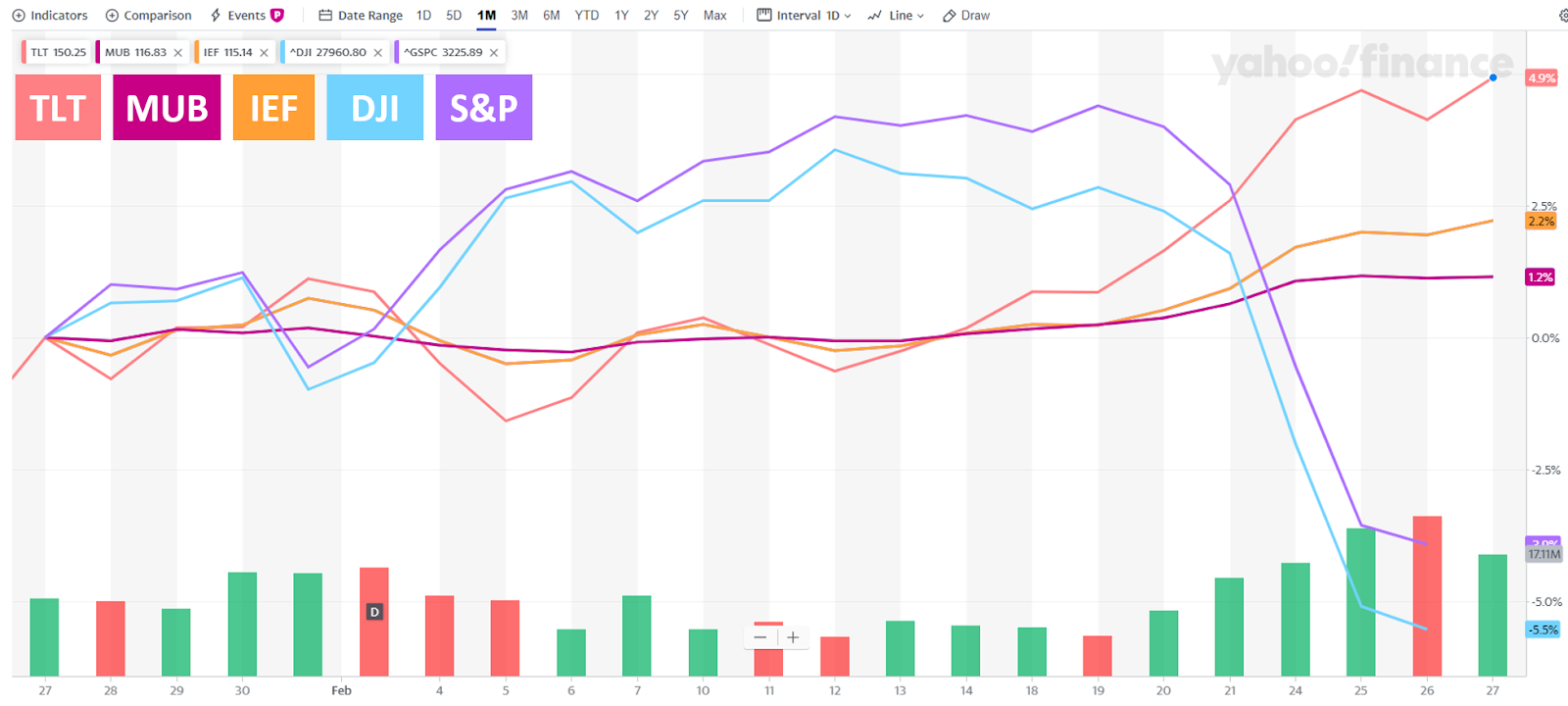
So, back to the positions we moved to, very defensive – treasuries, municipal bonds, 10 and 20-year treasuries, and utilities – all very defensive in nature in our portfolio build. Here’s why. Inflows represented by these three here, treasuries, municipal bonds, 10 and 20-year Treasury. We saw inflows starting back here (end of January, beginning of February) into bonds, very high. We had this continuation of a rally again that had no support, no confirmation from any of the other sectors that the yields from the treasuries on the 10, 20 or 30-year, were crashing. And ultimately, here’s what has happened. Look at those treasuries and municipal bond positions up and then your S&P 500 and Dow Jones down this past week. 

So again, it was the correct move to make it that time. And again, this is just part of what we’re looking at. We also look at credit spreads and many other things that most of you would probably find boring – basically, you’d probably rather go to the dentist and have your teeth cleaned then hear about all of those other things. But this is what we eat, this is what we breathe, this is what we love to do.

I want to thank all of you for allowing me to be part of your life. If you have any questions, any concerns about what we’ve discussed and what you’re hearing, please feel free to give me a call. Because at this point, as I mentioned in the other videos, the Coronavirus was that outlier, the icing on the cake. All this data that we were looking at, that was really the thing that said hey, I don’t think it’s being factored in. I don’t think China is telling us the whole story. We don’t know where that’s going to play out at this point and that’s far from over and we don’t know how that is going to affect our projections moving forward. But, time will tell.

So, in the meantime, we will be defensive. We will be here to answer any questions – give us a call, and have a wonderful sunny Thursday afternoon.


*Charts are from Yahoo! Finance and JC Parets

The information contained herein has been derived from sources believed to be reliable, but is not guaranteed as to accuracy and does not purport to be a complete analysis of any security, company, industry, or index. This report is not to be construed as an offer to sell or a solicitation of an offer to buy or sell any security. It is not intended to provide advice tailored to your specific situation. Past performance is no guarantee of future success. The information in this report in no way attempts to provide accounting, legal or tax advice. Investment advisory services offered through Motiv8 Investments, an SEC Registered Investment Advisor.

Measuring the Value of a Financial Adviser

Measuring the Value of a Financial Adviser

One study asserts that these relationships can make a difference for investors.

What is a relationship with a financial adviser worth to an investor? A 2019 study by Vanguard, one of the world’s largest money managers, attempts to answer that question.

Vanguard’s whitepaper concludes that when an investor works with an adviser and receives professional investment advice, they may see a net portfolio return about 3% higher over time.1

How did this study arrive at that conclusion? By comparing self-directed investor accounts to an adviser model, Vanguard found that the potential return relative to the average investor experience was higher for individuals who had financial advisers.1

Vanguard analyzed three key services that an adviser may provide: portfolio construction, wealth management, and behavioral coaching. It estimated that portfolio construction advice (e.g., asset allocation, asset location) could add up to 1.2% in additional return, while wealth management (e.g., rebalancing, drawdown strategies) may contribute over 1% in additional return.1

The biggest opportunity to add value was in behavioral coaching, which was estimated to be worth about 1.5% in additional return. Financial advisers can use their insight to guide clients away from poor decisions, such as panic selling or accepting excessive risk in a portfolio. Indeed, the greatest value of a financial adviser may be in helping individuals adhere to an agreed-upon financial and investment strategy.1

Of course, financial advisers can account for additional value not studied by Vanguard, such as helping clients implement wealth protection strategies, which protect against the financial consequences of loss of income, and coordinating with other financial professionals on tax management and estate planning.

You could argue that a financial adviser’s independence adds qualitative value. It should be noted that not all financial advisers are independent. Some are basically employees of brokerages, and they may be encouraged to promote and recommend certain investments of those brokerages to their clients.2

Both types of financial advisers may receive their compensation in two ways: through transaction fees and through ongoing fees. Financial advisory firms are required to disclose how their professionals are compensated with the Securities and Exchange Commission (SEC).2

After years of working with a financial adviser, the value of a relationship may be measured in both tangible and intangible ways. Many such investors are grateful they are not “going it alone.”

Questions? Please contact us: (215) 766-7002, info@aeinvestmentsgroup.com. Learn more about Brent E Chavez, Our Process, and the Services We Provide.

Citations
1 – advisors.vanguard.com/iwe/pdf/ISGQVAA.pdf [2/19]
2 – cnbc.com/2019/10/23/guide-to-choosing-the-right-financial-professional-for-you.html [10/23/19]

This material was prepared by MarketingPro, Inc., and does not necessarily represent the views of the presenting party, nor their affiliates. This information has been derived from sources believed to be accurate. Please note – investing involves risk, and past performance is no guarantee of future results. The publisher is not engaged in rendering legal, accounting or other professional services. If assistance is needed, the reader is advised to engage the services of a competent professional. This information should not be construed as investment, tax or legal advice and may not be relied on for the purpose of avoiding any Federal tax penalty. This is neither a solicitation nor recommendation to purchase or sell any investment or insurance product or service, and should not be relied upon as such. All indices are unmanaged and are not illustrative of any particular investment.

A Retirement Fact Sheet

A Retirement Fact Sheet

Some specifics about the “second act.”

Does your vision of retirement align with the facts? Here are some noteworthy financial and lifestyle facts about life after 50 that might surprise you. 

1. Up to 85% of a retiree’s Social Security income can be taxed. Some retirees are taken aback when they discover this. In addition to the Internal Revenue Service, 13 states currently levy taxes on some or all Social Security retirement benefits: Colorado, Connecticut, Kansas, Minnesota, Missouri, Montana, Nebraska, New Mexico, North Dakota, Rhode Island, Utah, Vermont, and West Virginia. (West Virginia, incidentally, is phasing out such taxation.)1

2. Retirees get a slightly larger standard deduction on their federal taxes. Actually, this is true for all taxpayers aged 65 and older, whether they are retired or not. Right now, the standard deduction for a single filer in this age bracket is $14,050, compared to $12,400 for those 64 or younger.2

3. Retirees can still use IRAs to save for retirement. There is no age limit for contributing to a Roth or Traditional IRA, as long as the owner earns income. So, a retiree can keep directing money into a Roth or Traditional IRA for life, provided they are not earning too much. 3

4. A significant percentage of retirees are carrying big debts. Looking at data from the Federal Reserve’s triennial Surveys of Consumer Finances, the median debt of senior households (age 65+) has more than doubled since the start of the century.4

The most stressful debt for seniors, according to a 2019 study from Ohio State University researchers, is credit card debt. The study calculates that each new dollar of credit card debt taken on by a senior household creates financial stress approximating an additional $14-20 of home loan debt.4

Moreover, a sudden financial liability may delay retirement. Another 2019 study, co-authored by researchers from the Urban Institute and the Congressional Budget Office, looks at the potential impact of a new $10,000 debt on an individual between 55-70 years old carrying the median amount of credit card debt for their age. The researchers concluded that this jump in debt would make a baby boomer 9% more likely to put off retiring.4

5. Fewer seniors live alone than you may think. The Administration for Community Living (a federal agency) says around 14% of older adults (65+) live by themselves. With millennials living at home and blended and extended families becoming common, perhaps this is not so surprising. The ACL does note that nearly half of women older than age 75 are on their own.5

6. Just 15% of women say they have a retirement strategy set down in writing. This factoid comes from the 2019 Transamerica Retirement Survey of American Workers. Another 42% say they have unwritten strategies. The remaining 43%? No strategy at all.6

7. Few older Americans budget for travel expenses. While retirees certainly love to travel, a Merrill Lynch study says that only about a third of people aged 50 and older earmark funds for their trips.7

What financial facts should you consider as you retire? What monetary realities might you need to acknowledge as your retirement progresses from one phase to the next? The reality of retirement may surprise you. If you have not met with a financial professional about your retirement savings and income needs, you may wish to do so. When it comes to retirement, the more information you have, the better. 


Are you ready to get your retirement plan in place? Schedule a consultation with us today to get started:

Schedule A Consultation

Citations
1 – aarp.org/retirement/social-security/questions-answers/how-is-ss-taxed.html [4/9/19]
2 – efile.com/tax-deduction/federal-standard-deduction/ [12/4/19]
3 – investopedia.com/articles/retirement/09/over-70-retirement-plans.asp [11/13/19]
4 – nextavenue.org/retirement-older-americans-debt/ [8/9/19]
5 – forbes.com/sites/howardgleckman/2018/05/04/a-new-snapshot-of-older-adults-in-the-us/ [5/4/18]
6 – transamericacenter.org/docs/default-source/women-and-retirement/tcrs2019_op_women_and_retirement_fact_sheet.pdf [11/19]
7 – kiplinger.com/article/retirement/T037-C032-S014-5-surprising-facts-to-know-about-retirement.html [11/11/19]

This material was prepared by MarketingPro, Inc., and does not necessarily represent the views of the presenting party, nor their affiliates. This information has been derived from sources believed to be accurate. Please note – investing involves risk, and past performance is no guarantee of future results. The publisher is not engaged in rendering legal, accounting or other professional services. If assistance is needed, the reader is advised to engage the services of a competent professional. This information should not be construed as investment, tax or legal advice and may not be relied on for avoiding any Federal tax penalty. This is neither a solicitation nor recommendation to purchase or sell any investment or insurance product or service, and should not be relied upon as such. All indices are unmanaged and are not illustrative of any particular investment.

The Major Retirement Planning Mistakes

The Major Retirement Planning Mistakes

Why are they made again and again?

retirement mistakes, warning sign

Much is out there about the classic financial mistakes that plague start-ups, family businesses, corporations, and charities. Aside from these blunders, some classic financial missteps plague retirees.   

Calling them “mistakes” may be a bit harsh, as not all of them represent errors in judgment. Yet whether they result from ignorance or fate, we need to be aware of them as we plan for and enter retirement.        

1. Leaving work too early. As Social Security benefits rise about 8% for every year you delay receiving them, waiting a few years to apply for benefits can position you for higher retirement income. Filing for your monthly benefits before you reach Social Security’s Full Retirement Age (FRA) can mean comparatively smaller monthly payments. Meanwhile, if you can delay claiming Social Security, that positions you for more significant monthly benefits.1     

2. Underestimating medical bills. In its latest estimate of retiree health care costs, the Center for Retirement Research at Boston College says that the average retiree will need at least $4,300 per year to pay for future health care costs. Medicare will not pay for everything. That $4,300 represents out-of-pocket costs, which includes dental, vision, and long-term care.2     

3. Taking the potential for longevity too lightly. Actuaries at the Social Security Administration project that around a third of today’s 65-year-olds will live to age 90, with about one in seven living 95 years or longer. The prospect of a 20- or 30-year retirement is not unreasonable, yet there is still a lingering cultural assumption that our retirements might duplicate the relatively brief ones of our parents.3

4. Withdrawing too much each year. You may have heard of the “4% rule,” a guideline stating that you should take out only about 4% of your retirement savings annually. Many cautious retirees try to abide by it.

So, why do others withdraw 7% or 8% a year? In the first phase of retirement, people tend to live it up; more free time naturally promotes new ventures and adventures and an inclination to live a bit more lavishly.         

tax efficiency, budgeting, planning

5. Ignoring tax efficiency & fees. It can be a good idea to have both taxable and tax-advantaged accounts in retirement. Assuming your retirement will be long, you may want to assign this or that investment to its “preferred domain.” What does that mean? It means the taxable or tax-advantaged account that may be most appropriate for it as you pursue a better after-tax return for the whole portfolio.

Many younger investors chase the return. Some retirees, however, find a shortfall when they try to live on portfolio income. In response, they move money into stocks offering significant dividends or high-yield bonds – something you might regret in the long run. Taking retirement income off both the principal and interest of a portfolio may give you a way to reduce ordinary income and income taxes.   

6. Avoiding market risk. Equity investment does invite risk, but the reward may be worth it. In contrast, many fixed-rate investments offer comparatively small yields these days.    

7. Retiring with heavier debts. It is hard to preserve (or accumulate) wealth when you are handing portions of it to creditors.   

8. Putting college costs before retirement costs. There is no “financial aid” program for retirement. There are no “retirement loans.” Your children have their whole financial lives ahead of them. Try to refrain from touching your home equity or your IRA to pay for their education expenses.   

maze, retirement plan

9. Retiring with no plan or investment strategy. An unplanned retirement may bring terrible financial surprises; the absence of a strategy can leave people prone to market timing and day trading.

These are some of the classic retirement planning mistakes. Why not plan to avoid them? Take a little time to review and refine your retirement strategy in the company of the financial professional you know and trust.

Do you have your retirement plan in place? Set up your FREE initial consultation with Brent E Chavez today:

Schedule A Consultation

Learn more about Brent E Chavez, the Services We Provide, and Our Philosophy. Do you have any questions? Give us a shout: Contact Us, info@aeinvestmentsgroup.com, (215) 766-7002.

Citations
1 – forbes.com/sites/bobcarlson/2019/01/25/5-ways-to-maximize-social-security-benefits [1/25/19]
2 – fool.com/retirement/2019/12/11/4-steps-to-making-sure-youre-ready-to-retire.aspx [12/11/2019]
3 – ssa.gov/planners/lifeexpectancy.html [12/11/2019]

This material was prepared by MarketingPro, Inc., and does not necessarily represent the views of the presenting party, nor their affiliates. This information has been derived from sources believed to be accurate. Please note – investing involves risk, and past performance is no guarantee of future results. The publisher is not engaged in rendering legal, accounting or other professional services. If assistance is needed, the reader is advised to engage the services of a competent professional. This information should not be construed as investment, tax or legal advice and may not be relied on for the purpose of avoiding any Federal tax penalty. This is neither a solicitation nor recommendation to purchase or sell any investment or insurance product or service, and should not be relied upon as such. All indices are unmanaged and are not illustrative of any particular investment.

February Newsletter

MONTHLY NEWS AND INFORMATION FOR CURRENT AND FUTURE RETIREES

PRESENTED BY BRENT E. CHAVEZ – FEBRUARY 2020


QUOTE OF THE MONTH

“Rest is the sweet sauce of labor.”
– PLUTARCH


WHAT MATTERS MORE IN RETIREMENT: INCOME, OR SAVINGS?

Retirement saving is not just about accumulating assets. It is also about laying the groundwork for retirement spending. Any retirement strategy has a core goal: the goal of helping an individual or couple pursue their retirement dreams once their careers have concluded. So, from that perspective, the amount that needs to be saved directly relates to the amount a retiree household may need to spend. To live your best retirement, your degree of retirement savings needs to be great enough to try and correspond to that vision.

Often, articles state that pre-retirees will need to live on 70% to 80% of their final working incomes. This is a general guideline, yet it may or may not prove true for a particular household. Some people retire and find they are spending less than they once did. Others spend as much as they did while working, maybe even a bit more, due to traveling, hobbies, and social engagements. What does this imply for retirement saving? While you arguably cannot save too much for the future, you can save too little.1

Travel Tip

Clear cookies, and you might score a cheaper flight

Airlines use dynamic pricing to adjust airfares relative to demand, and they can actually do this per consumer. Most airline websites screen your search history, including the browser cookies you may have picked up while visiting other airline or travel websites. Based on these cookies, they may present you with more expensive flights than they would otherwise. Deleting cookies from your browser just before a fare search may help you avoid this dynamic pricing.
Source: MSN2


HOW THE SECURE ACT IMPACTS RETIREMENT ACCOUNTS

A new federal law, the Setting Up Every Community for Retirement Enhancement (SECURE) Act, directly affects retirees and retirement savers. It changes the rules regarding “stretching” an Individual Retirement Account (IRA) as well as longstanding retirement account rules keyed to age 70½.

Under the SECURE ACT, in most circumstances, once you reach age 72, you must begin taking required minimum distributions (RMDs) from traditional Individual Retirement Accounts (IRAs) and most other employer-sponsored retirement plans. (This new RMD rule applies only to those who will turn 70½ in 2020 or later.) The SECURE ACT also lets seniors contribute to traditional retirement accounts after age 70½, as long as they have earned income; previously, this was forbidden. Both these changes have big implications for savers; large account balances can potentially grow and compound a little more before being drawn down, and amounts contributed after age 70½ could have a chance to compound as well. Turning to the workplace, the SECURE ACT allows employer-sponsored retirement plans the option to include insurance products, offering the potential for lifelong income. It also opens a door for small businesses to join multi-employer group retirement plans (MEPs). 

The new law does curtail the Stretch IRA estate strategy. Anyone who inherits an IRA of any kind in 2020 or later must withdraw the whole IRA balance within 10 years of the IRA owner’s death and pay linked taxes, unless that heir is a minor child or a surviving spouse. (Existing inherited IRAs are exempt from the new rules.) The SECURE Act is certainly worth a conversation.3,4

Learn more: The SECURE Act

Withdrawals from Traditional IRAs are taxed as ordinary income and, if taken before age 59½, may be subject to a 10% federal income tax penalty.

Under the SECURE Act, your required minimum distribution (RMD) must be distributed by the end of the 10th calendar year following the year of the Individual Retirement Account (IRA) owner’s death. Penalties may occur for missed RMDs. Any RMDs due for the original owner must be taken by their deadlines to avoid penalties. A surviving spouse of the IRA owner, disabled or chronically ill individuals, individuals who are not more than 10 years younger than the IRA owner, and child of the IRA owner who has not reached the age of majority may have other minimum distribution requirements.

DID YOU KNOW?

The Romans may have built the earliest retirement villages

In the first century B.C., Julius Caesar, Sulla, and other Roman generals founded special colonae (colonies) to serve as retirement communities for Roman army veterans. Pompeii actually began as one of these communities.5


ARE BABY BOOMERS FLOCKING TO BIG CITIES?

A quick look at some federal government statistics provides a quick answer: no. Perhaps it seems like big cities are filled with baby boomers because of the simple fact that this demographic group is larger than others. Research does not back up this assumption, however. As a recent New York Times analysis of Census Bureau data noted, 17.2% of Americans aged 54-72 lived in urban areas in 2018; back in 1990, 21.6% did. This percentage declined gradually, but steadily, over these 28 years, and looking more closely at the decline, the 54- to 72-year-olds of 2018 were 11% less likely to live in urban neighborhoods than the 54- to 72-year-olds of 2000.

As other Census Bureau data from 1990-2018 reveals, the Americans most likely to live in urban settings have been those aged 25 to 29. The least likely? Those aged 70 to 74. The odds of urban living start to increase again after age 80. Even so, just two years ago, only 19.8% of Americans aged 85 or older lived in urban settings.6


ON THE BRIGHT SIDE

A fair number of employers are offering phased retirements. According to the Transamerica Center for Retirement Studies, 30% of U.S. companies permit their workers to move from full-time hours to part-time hours as part of a retirement transition, and 21% allow employees to move into less-stressful roles prior to retiring.7

BRAIN TEASER

What goes up and down each day, yet does not physically move?

STUMPED? CALL 215-766-7002 FOR THE ANSWER!


CITATIONS
1 – forbes.com/sites/kristinmckenna/2019/07/10/debunked-6-myths-about-retirement [7/10/19]
2 – msn.com/en-us/travel/tips/travel-tip-clear-your-browser-before-booking-a-flight-to-get-a-better-deal/ar-AAISUPG [10/17/19]

3 – inquirer.com/news/secure-act-retirement-2020-annuities-rmd-529-plan-taxes-20191223.html [12/23/19]
4 – investmentnews.com/the-stretch-ira-is-dead-175775 [12/27/19]

5 – livius.org/articles/concept/colonia/ [6/8/19]
6 – nytimes.com/2020/01/24/upshot/myth-urban-boomer.html [1/24/20]
7 – cnbc.com/2019/10/04/earning-income-after-65-how-to-make-it-work-for-you.html [10/4/19]

This material was prepared by MarketingPro, Inc., and does not necessarily represent the views of the presenting party, nor their affiliates. This information has been derived from sources believed to be accurate. The publisher is not engaged in rendering legal, accounting or other professional services. If assistance is needed, the reader is advised to engage the services of a competent professional. This information should not be construed as investment, tax or legal advice and may not be relied on for the purpose of avoiding any Federal tax penalty.

2019 IRA Deadlines Are Approaching

2019 IRA Deadlines Are Approaching

Here is what you need to know.

Financially, many of us associate April with taxes – but we should also associate April with important IRA deadlines.

April 1, 2020 is the deadline to take your Required Minimum Distribution (RMD) from certain individual retirement accounts.

A new federal law must be noted here. The Setting Every Community Up for Retirement Enhancement (SECURE) ACT, passed late in 2019, changed the age for the initial RMD for traditional IRAs and traditional workplace retirement plans. It lifted this age from 70½ to 72, effective as of 2020.1

So, if you were not 70½ or older when 2019 ended, you can wait to take your first RMD until age 72. If you were 70½ at the end of 2019, the old rules still apply, and your initial RMD deadline is April 1, 2020. Your second RMD will be due on December 31, 2020.1,2

Keep in mind that withdrawals from traditional, SIMPLE, and SEP-IRAs are taxed as ordinary income, and if taken before age 59½, may be subject to a 10% federal income tax penalty.

To qualify for the tax-free and penalty-free withdrawal of earnings from a Roth IRA, your Roth IRA distributions must meet a five-year holding requirement and occur after age 59½. Tax-free and penalty-free withdrawals can also be taken under certain other circumstances, such as a result of the owner’s death. The original Roth IRA owner is not required to take minimum annual withdrawals.

April 15, 2020 is the deadline for making annual contributions to a traditional IRA, Roth IRA, and certain other retirement accounts.3

The earlier you make your annual IRA contribution, the better. You can make a yearly IRA contribution any time between January 1 of the current year and April 15 of the next year. So, the contribution window for 2019 started on January 1, 2019 and ends on April 15, 2020. Accordingly, you can make your IRA contribution for 2020 any time from January 1, 2020 to April 15, 2021.4

You may help manage your income tax bill if you are eligible to contribute to a traditional IRA. To get the full tax deduction for your 2019 traditional IRA contribution, you have to meet one or more of these financial conditions:

• You aren’t eligible to participate in a workplace retirement plan.

• You are eligible to participate in a workplace retirement plan, but you are a single filer or head of household with Modified Adjusted Gross Income (MAGI) of $64,000 or less. (Or if you file jointly with your spouse, your combined MAGI is $103,000 or less.)5

• You aren’t eligible to participate in a workplace retirement plan, but your spouse is eligible and your combined 2019 gross income is $193,000 or less.6

Thanks to the SECURE Act, both traditional and Roth IRA owners now have the chance to contribute to their IRAs as long as they have taxable compensation (and in the case of Roth IRAs, MAGI below a certain level; see below).1,4

If you are making a 2019 IRA contribution in early 2020, you must tell the investment company hosting the IRA account which year the contribution is for. If you fail to indicate the tax year that the contribution applies to, the custodian firm may make a default assumption that the contribution is for the current year (and note exactly that to the I.R.S.).

So, write “2020 IRA contribution” or “2019 IRA contribution,” as applicable, in the memo area of your check, plainly and simply. Be sure to write your account number on the check. If you make your contribution electronically, double-check that these details are communicated.

How much can you put into an IRA this year? You can contribute up to $6,000 to a Roth or traditional IRA for the 2020 tax year; $7,000, if you will be 50 or older this year. (The same applies for the 2019 tax year). Should you make an IRA contribution exceeding these limits, you have until the following April 15 to correct the contribution with the help of an I.R.S. form. If you don’t, the amount of the excess contribution will be taxed at 6% each year the correction is avoided.3,4

The maximum contribution to a Roth IRA may be reduced because of Modified Adjusted Gross Income (MAGI) phaseouts, which kick in as follows.

2019 Tax Year7
• Single/head of household: $122,000 – $137,000
• Married filing jointly: $193,000 – $203,000          

2020 Tax Year8
• Single/head of household: $124,000 – $139,000
• Married filing jointly: $196,000 – $206,000

The I.R.S. has other rules for other income brackets. If your MAGI falls within the applicable phase-out range, you may be eligible to make a partial contribution.7,8 A last reminder for those who turned 70½ in 2019: you need to take your first traditional IRA RMD by April 1, 2020 at the latest. The investment company that serves as custodian (host) of your IRA should have alerted you to this deadline; in fact, they have probably calculated the RMD amount for you. Your subsequent RMD deadlines will all fall on December 31.2

Do you have any questions? Please contact us! info@aeinvestmentsgroup.com, 215-766-7002.

Citations
1 – marketwatch.com/story/with-president-trumps-signature-the-secure-act-is-passed-here-are-the-most-important-things-to-know-2019-12-21 [1/8/20]
2 – kiplinger.com/article/retirement/T045-C000-S001-the-deadline-for-your-first-rmd-is-april-1.html [3/29/19]
3 – irs.gov/retirement-plans/ira-year-end-reminders [11/8/19]
4 – irs.gov/retirement-plans/traditional-and-roth-iras [1/8/20]
5 – irs.gov/retirement-plans/2019-ira-deduction-limits-effect-of-modified-agi-on-deduction-if-you-are-covered-by-a-retirement-plan-at-work [11/18/19]
6 – irs.gov/retirement-plans/2019-ira-deduction-limits-effect-of-modified-agi-on-deduction-if-you-are-not-covered-by-a-retirement-plan-at-work [11/18/19]
7 – irs.gov/retirement-plans/amount-of-roth-ira-contributions-that-you-can-make-for-2019 [11/18/19]
8 – irs.gov/retirement-plans/plan-participant-employee/amount-of-roth-ira-contributions-that-you-can-make-for-2020 [11/8/19]

This material was prepared by MarketingPro, Inc., and does not necessarily represent the views of the presenting party, nor their affiliates. This information has been derived from sources believed to be accurate. Please note – investing involves risk, and past performance is no guarantee of future results. The publisher is not engaged in rendering legal, accounting or other professional services. If assistance is needed, the reader is advised to engage the services of a competent professional. This information should not be construed as investment, tax or legal advice and may not be relied on for the purpose of avoiding any Federal tax penalty. This is neither a solicitation nor recommendation to purchase or sell any investment or insurance product or service, and should not be relied upon as such. All indices are unmanaged and are not illustrative of any particular investment.