Menu Close

Annual Financial To-Do List

Annual Financial To-Do List

Things you can do for your future as the year unfolds.

What financial, business, or life priorities do you need to address for the coming year? Now is an excellent time to think about the investing, saving, or budgeting methods you could employ toward specific objectives, from building your retirement fund to managing your taxes. You have plenty of choices. Here are a few ideas to consider:

Can you contribute more to your retirement plans this year? In 2022, the contribution limit for a Roth or traditional individual retirement account (IRA) is expected to remain at $6,000 ($7,000 for those making “catch-up” contributions). Your modified adjusted gross income (MAGI) may affect how much you can put into a Roth IRA. With a traditional IRA, you can contribute if you (or your spouse if filing jointly) have taxable compensation, but income limits are one factor in determining whether the contribution is tax-deductible.1

Keep in mind, this article is for informational purposes only and not a replacement for real-life advice. Also, tax rules are constantly changing, and there is no guarantee that the tax landscape will remain the same in years ahead.

Once you reach age 72, you must begin taking required minimum distributions from a traditional Individual Retirement Account in most circumstances. Withdrawals from Traditional IRAs are taxed as ordinary income and, if taken before age 59½, may be subject to a 10% federal income tax penalty.

To qualify for the tax-free and penalty-free withdrawal of earnings, Roth 401(k) distributions must meet a five-year holding requirement and occur after age 59½. Tax-free and penalty-free withdrawal can also be taken under certain other circumstances, such as the owner’s death. Employer match is pretax and not distributed tax-free during retirement. 

Make a charitable gift. You can claim the deduction on your tax return, provided you follow the Internal Review Service guidelines and itemize your deductions with Schedule A. The paper trail can be important here. If you give cash, you should consider documenting it. Some contributions can be demonstrated by a bank record, payroll deduction record, credit card statement, or written communication from the charity with the date and amount. Incidentally, the IRS does not equate a pledge with a donation. If you pledge $2,000 to a charity this year but only end up gifting $500, you can only deduct $500.2

Make certain to consult your tax, legal, or accounting professional before modifying your record-keeping approach or your strategy for making charitable gifts. 

See if you can take a home office deduction for your small business. If you are a small-business owner, you may want to investigate this. You may be able to write off expenses linked to the portion of your home used to conduct your business. Using your home office as a business expense involves a complex set of tax rules and regulations. Before moving forward, consider working with a professional who is familiar with the tax rules as they relate to home-based businesses.3

Open an HSA. A Health Savings Account (HSA) works a bit like your workplace retirement account. There are also some HSA rules and limitations to consider. You are limited to a $3,650 contribution for 2022 if you are single; $7,300 if you have a spouse or family. Those limits jump by a $1,000 “catch-up” limit for each person in the household over age 55.4

If you spend your HSA funds for non-medical expenses before age 65, you may be required to pay ordinary income tax as well as a 20% penalty. After age 65, you may be required to pay ordinary income taxes on HSA funds used for nonmedical expenses. HSA contributions are exempt from federal income tax; however, they are not exempt from state taxes in certain states.

Pay attention to asset location. Tax-efficient asset location is one factor that can be considered when creating an investment strategy.  

Review your withholding status. Should it be adjusted due to any of the following factors?

  • You tend to pay the federal or state government at the end of each year.
  • You tend to get a federal tax refund each year. 
  • You recently married or divorced.
  • You have a new job, and your earnings have been adjusted. 

Consider consulting your tax, human resources, or accounting professional before modifying your withholding status.

Did you get married in 2021? If so, it may be an excellent time to review the beneficiaries of your retirement accounts and other assets. The same goes for your insurance coverage. If you are preparing to have a new last name in 2022, you may want to get a new Social Security card. Additionally, retirement accounts may need to be revised or adjusted?

Are you coming home from active duty? If so, go ahead and check on the status of your credit and any tax and legal proceedings that might have been preempted by your orders.  

Consider the tax impact of any upcoming transactions. Are you preparing to sell any real estate this year? Are you starting a business? Might any commissions or bonuses come your way in 2022? Do you anticipate selling an investment that is held outside of a tax-deferred account? 

If you are retired and in your seventies, remember your RMDs. In other words, Required Minimum Distributions (RMDs) from retirement accounts. In most circumstances, once you reach age 72, you must begin taking RMDs from most types of these accounts.5 

Vow to focus on your overall health and practice sound financial habits in 2022. And don’t be afraid to ask for help from professionals who understand your individual situation.


Citations
1. thefinancebuff.com, August 11, 2021
2. irs.gov, January 22, 2021
3. nerdwallet.com, July 31, 2020
4. irs.gov, September 8, 2021
5. irs.gov, May 3, 2021

Should You Care What the Financial Markets Do Each Day?

Should You Care What the Financial Markets Do Each Day?

Focusing on Your Strategy During Turbulent Times.

Investors are people, and people are often impatient. No one likes to wait in line or wait longer than they have to for something, especially today when so much is just a click or two away.

This impatience also manifests itself in the financial markets. When stocks slip, for example, some investors grow uneasy. Their impulse is to sell, get out, and get back in later. If they give in to that impulse, they may effectively pay a price.

Across the 30 years ended December 31, 2018, the Standard & Poor’s 500 posted averaged annual return of 10.0%. During the same period, the average mutual fund stock investor realized a yearly return of just 4.1%. Why the difference? It could partly stem from impatience.1

It’s important to remember that past performance does not guarantee future results. The return and principal value of stock prices will fluctuate over time as market conditions change. And shares, when sold, may be worth more or less than their original cost.

Investors can worry too much. In the long run, an investor who glances at a portfolio once per quarter may end up making more progress toward his or her goals than one who anxiously pores over financial websites each day.

Too many investors make quick, emotional moves when the market dips. Logic may go out the window when this happens, in addition to perspective.

Some long-term investors keep focus. Warren Buffett does. He has famously said that an investor should, “buy into a company because you want to own it, not because you want the stock to go up.2 

Buffett often tries to invest in companies whose shares may perform well in both up and down markets. He also has famously stated, “If you aren’t willing to own a stock for ten years, don’t even think about owning it for ten minutes.”2

In contrast with Buffett’s patient long-term approach, investors who care too much about day-to-day market behavior may practice market timing, which is as much hope as strategy. 

To make market timing work, an investor has to be right twice. The goal is to sell high, take profits, and buy back in just as the market begins to rally off a bottom. But there is volatility in financial markets and the sale at any point could result in a gain or loss.

Even Wall Street professionals have a hard time predicting market tops and bottoms. Retail investors are notorious for buying high and selling low. 

Investors who alter their strategy in response to the headlines may end up changing it again after further headlines. While they may expect to be on top of things by doing this, their returns may suffer from their emotional and impatient responses.

Nobel Laureate economist Gene Fama once commented: “Your money is like soap. The more you handle it, the less you’ll have.” Wisdom that may benefit your strategy, especially during periods of market volatililty.3

How have your investments performed through these turbulent times?

Questions? Please do not hesitate to contact us: info@aeinvestmentsgroup.com, (215) 766-7002

Citations
1 – nytimes.com/2019/07/26/your-money/stock-bond-investing.html [7/26/19]
2 – fool.com/investing/best-warren-buffett-quotes.aspx [8/30/19]
3 – suredividend.com/best-investment-quotes/ [12/5/18]


Mutual funds are sold only by prospectus. Please consider the charges, risks, expenses and investment objectives carefully before investing. A prospectus containing this and other information about the investment company can be obtained from your financial professional. Read it carefully before you invest or send money.

This material was prepared by MarketingPro, Inc., and does not necessarily represent the views of the presenting party, nor their affiliates. This information has been derived from sources believed to be accurate. Please note – investing involves risk, and past performance is no guarantee of future results. The publisher is not engaged in rendering legal, accounting or other professional services. If assistance is needed, the reader is advised to engage the services of a competent professional. This information should not be construed as investment, tax or legal advice and may not be relied on for the purpose of avoiding any Federal tax penalty. This is neither a solicitation nor recommendation to purchase or sell any investment or insurance product or service, and should not be relied upon as such. All indices are unmanaged and are not illustrative of any particular investment.

Investing for Impact

Investing for Impact

Socially responsible investment strategies and you.

SRI (Socially Responsible Investing), Impact Investing, and ESG (Environmental, Social, and Governance) Investing belong to a growing category of investment choices that use traditional investing practices to responsibly impact society.

In the past, these investment strategies were viewed as too restrictive for most investors. But over time, improved evaluative data and competitive returns have pushed these strategies into the mainstream. Even though SRI, ESG investing, and impact investing share many similarities, they differ in some fundamental ways. Read on to learn more.1

ESG Investing assesses how specific criteria of an investment, such as its environmental, social, and governance practices, may impact its performance. These factors are used in an evaluative capacity. In the United States alone, there are more than 350 ESG mutual funds and ETFs available.2,3,4

SRI (Socially Responsible Investing) uses criteria from ESG investing to actively eliminate or select investments according to ethical guidelines. SRI investors may use ESG factors to apply negative or positive screens when choosing how to build their portfolio. For example, an investor may wish to allocate a portion of their portfolio to companies that contribute to charitable causes. In the U.S., more than 12 trillion dollars are currently invested according to SRI strategies.4,5

Impact Investing or thematic investing differs from the two above. The main goal of impact investing is to secure a positive outcome regardless of profit. For example, an impact investor may use ESG criteria to find and invest in a company dedicated to the development of a cure for cancer despite whether success is guaranteed.6

The biggest take away? There have never been more choices for keeping your investments aligned with your personal beliefs. But no matter how you decide to structure your investments, don’t forget it’s always a smart move to speak with your financial professional before making a major change. 

Citations
1 – https://investor.vanguard.com/investing/esg/ [01/01/2020]
2 – Investing in mutual funds is subject to risk and potential loss of principal. There is no assurance or certainty that any investment or strategy will be successful in meeting its objectives. Investors should consider the investment objectives, risks, charges, and expenses of the fund carefully before investing. The prospectus contains this and other information about the funds. Contact the fund company directly or your financial professional to obtain a prospectus, which should be read carefully before investing or sending money.
3 – Exchange Traded Funds (ETFs) are subject to market and the risks of their underlying securities. Some ETFs may involve international risks, which include differences in financial reporting standards, currency exchange rates, political risk unique to a specific country, foreign taxes and regulations, and the potential for illiquid markets. These factors may result in greater share price volatility. ETFs that focus on a small universe of securities may be subject to more market volatility as well as the specific risks that accompany the sector, region or group. An ETFs trading price may be at a premium or discount to the net asset value of the underlying securities.
4 –
https://www.morningstar.com/content/dam/marketing/shared/pdfs/sustainability/Sustainable_Funds_Landscape_2018.pdf?cid=EMQ_ [02/04/2019]
5 – Asset allocation is an approach to help manage investment risk. Asset allocation does not guarantee against investment loss.
6 –
https://www.ussif.org/sribasics [08/02/2019]


This material was prepared by MarketingPro, Inc., and does not necessarily represent the views of the presenting party, nor their affiliates. This information has been derived from sources believed to be accurate. Please note – investing involves risk, and past performance is no guarantee of future results. The publisher is not engaged in rendering legal, accounting or other professional services. If assistance is needed, the reader is advised to engage the services of a competent professional. This information should not be construed as investment, tax or legal advice and may not be relied on for the purpose of avoiding any Federal tax penalty. This is neither a solicitation nor recommendation to purchase or sell any investment or insurance product or service, and should not be relied upon as such. All indices are unmanaged and are not illustrative of any particular investment.

Position & Market Update 2-27-2020

Video Transcript:

Hello everyone. Brent Chavez, Aequitas Equitas Investment Group. I hope this video finds you well. It is Thursday afternoon, and we are in the midst of a market crash that is somewhat unprecedented in it being a draw down in such a short period of time. I just wanted to give you a follow up and tell you again, where we stand, a follow-up to the two videos I sent you this last month of what we’re doing to protect your portfolios, has been working tremendously. But, I want to go a little bit deeper as to what we saw, what we’re seeing that made us do something that is very rare for us as a practice to go so defensive. As many of you know, it’s not something we like to do, those that have been with us for a long period of time. 

I’m going to share with you some things that we saw going on at the end of January that concerned us. As I mentioned in my video from January, we had had a big run up. We had stretch valuations in the markets. We were seeing a flight to bonds, globally, inflows to bonds were really up ticking. And as the yields were dropping, buyers would come in, grab those bonds. No matter how low those yields were, buyers were showing up. And at the same time seeing the deterioration of the many individual stocks in indexes in sectors globally that was a concern to us. We’re going to touch on again this is not going to be all encompassing of what we’re looking at for you on a daily, weekly, monthly basis, but just a little bit deeper than the last two videos have been. 

So again, back here in January, the S&P had hit a short term target that we had around 3300. We had noticed as we looked around, there were some canaries in the mines and red flags, so to speak. We’re going to take a look at them.

We see here some sideways action in the S&P 500. We saw it ticking up for a few weeks after we went defensive with all your portfolios, but we felt that that was more or less a “sucker’s rally,” as I like to call people being taken in before the fall off the cliff, potentially was going to take place. We’re here today as we do this video around 3000, a little over 3000. So again, a pretty sizable pullback in a very short period of time, not something that we knew was going to happen, not something that we said was absolutely going to happen… we actually said we don’t know what tomorrow brings when it comes to the stock markets. The only thing we can do and we do do for all of you is to look at the data and make educated decisions based on the data that we see come in. 

We’re going to move a little bit further into our next chart. 

Here was something that got concerning here over a couple month period – this is the chart of the 10 year Treasury. We saw yields collapsing in that 10-year. It touched against 1.39 for the 10-year Treasury. But the problem was, buyers kept showing up, flows kept going that way, it was a little bit of what we thought to be a warning sign. In fact, a very important chart to look at as to why we want to be more neutral and defensive in our portfolios. It has collapsed through this resistance and I feel moving forward we’re going to see much lower yields, much lower interest rates, Federal Reserve it’s important for you to come into lower rates. We’re getting less and less ammo… as you see the scale, we’re getting to the fractions because there’s not much to zero from here. So again we’re concerned, though, that it may push lower for the foreseeable future. So we want to stay positioned as we are for now. 

The next chart that we’re looking at is the financials. 

I talk about being able to have confirmation besides the S&P and the Dow Jones. Looking at the charts we want to see some other charts that really give us confirmation that these moves are real, that there’s more than just a handful of stocks like the S&P 500 – basically you have 5 stocks pulling it up the last several weeks, the big mega cap stocks, where the rest of the stocks in that index were breaking down, deteriorating from a technical standpoint. Financials is an important part to any stock market rally that is sustainable or able to move forward. In the past I had talked about this resistance, all time highs in the XLF ETF representing financials in the S&P 500. All time high back in 2008, we hit it in ‘16, pull down before the next several years sideways, and than finally joined the rally of the S&P 500. But, again hit that resistance and the S&P 500 continued to move up and financials moved sideways… no confirmation that this rally had legs to move much higher. 

We’re going to see that on a chart here. 

Here’s where we see confirmation of the S&P, in purple, XLF moving, confirming these moves up. We started seeing issues and real big issues here (past few weeks), a canary in the mine. 

Let’s look at our next chart and data we’re looking at. 

The Dow Jones Industrial one of the indexes that every night you see or hear in the news, “record high” with the S&P 500, the NASDAQ.  When the Dow Jones Industrial is making moves we want some confirmation that it is a real sustainable move. And we want to get that confirmation from the Dow Jones Transports, DJT. What is the difference? 

Well, here’s the light blue line, this is the Dow Jones Industrial, again you see that on TV every night, the dark blue line is the Dow Jones Transports. So the Dow Jones Industrial, 30 industrial companies, making a lot of goods that Americans consume and the globe consumes. So with that being said, the companies that move the goods throughout the country throughout the world should be doing similarly good. And we saw something that happened, starting back at the end of last year, we started to see a separation of those charts. We started to see that we were not getting confirmation. When I sent out the video back in January, the Dow Jones Industrial had done about 13% in the last year and the Dow Jones Transports had done 3%.

So again we were seeing a divergence that was growing and growing – red flag or a canary in the mine. Again, a big divergence was taking place here in January, a sign that not all was well for the markets to continue much higher and uninterrupted with some form of a pullback. 

Let’s look at our next piece of data we were looking at. Oil. 

Because what happened was the markets were humming along, hitting all time highs, but oil was falling off the cliff, about $10 a barrel, in that very short period of time of about a month. If the economy’s rocking and rolling, the global economy is ready to take off and help support the S&P 500 and Dow Jones companies to really help their evaluations from a fundamental standpoint and help them grow into 2020, 2021… but, oil was telling a different story. Again, it was another thing that had us concerned that we might want to be more defensive in our posture. 

Here’s another chart that we want to take a look at. 

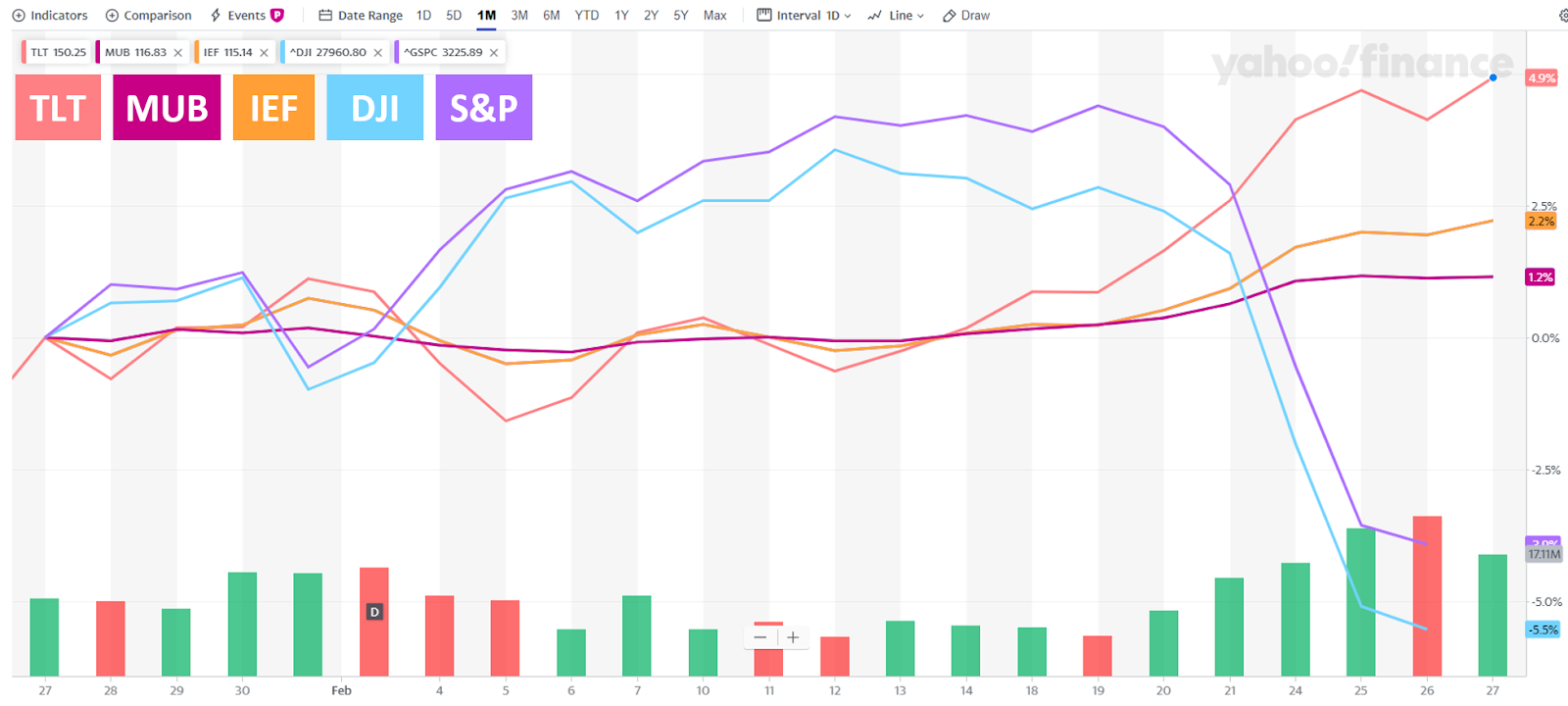
So, back to the positions we moved to, very defensive – treasuries, municipal bonds, 10 and 20-year treasuries, and utilities – all very defensive in nature in our portfolio build. Here’s why. Inflows represented by these three here, treasuries, municipal bonds, 10 and 20-year Treasury. We saw inflows starting back here (end of January, beginning of February) into bonds, very high. We had this continuation of a rally again that had no support, no confirmation from any of the other sectors that the yields from the treasuries on the 10, 20 or 30-year, were crashing. And ultimately, here’s what has happened. Look at those treasuries and municipal bond positions up and then your S&P 500 and Dow Jones down this past week. 

So again, it was the correct move to make it that time. And again, this is just part of what we’re looking at. We also look at credit spreads and many other things that most of you would probably find boring – basically, you’d probably rather go to the dentist and have your teeth cleaned then hear about all of those other things. But this is what we eat, this is what we breathe, this is what we love to do.

I want to thank all of you for allowing me to be part of your life. If you have any questions, any concerns about what we’ve discussed and what you’re hearing, please feel free to give me a call. Because at this point, as I mentioned in the other videos, the Coronavirus was that outlier, the icing on the cake. All this data that we were looking at, that was really the thing that said hey, I don’t think it’s being factored in. I don’t think China is telling us the whole story. We don’t know where that’s going to play out at this point and that’s far from over and we don’t know how that is going to affect our projections moving forward. But, time will tell.

So, in the meantime, we will be defensive. We will be here to answer any questions – give us a call, and have a wonderful sunny Thursday afternoon.


*Charts are from Yahoo! Finance and JC Parets

The information contained herein has been derived from sources believed to be reliable, but is not guaranteed as to accuracy and does not purport to be a complete analysis of any security, company, industry, or index. This report is not to be construed as an offer to sell or a solicitation of an offer to buy or sell any security. It is not intended to provide advice tailored to your specific situation. Past performance is no guarantee of future success. The information in this report in no way attempts to provide accounting, legal or tax advice. Investment advisory services offered through Motiv8 Investments, an SEC Registered Investment Advisor.

The Sequence of Returns

The Sequence of Returns

A look at how variable rates of return do (and do not) impact investors over time.

What exactly is the “sequence of returns”? The phrase describes the yearly variation in an investment portfolio’s rate of return. Across 20 or 30 years of saving and investing for the future, what kind of impact do these deviations from the average return have on a portfolio’s final value?

The answer: no impact at all.

Once an investor retires, however, these ups and downs can have an effect on portfolio value – and retirement income.

During the accumulation phase, the sequence of returns is ultimately inconsequential. Yearly returns may vary greatly or minimally; in the end, the variance from the mean hardly matters. (Think of “the end” as the moment the investor retires: the time when the emphasis on accumulating assets gives way to the need to withdraw assets.)

An analysis from BlackRock bears this out. The asset manager compares three model investing scenarios: three investors start portfolios with lump sums of $1 million, and each of the three portfolios averages a 7% annual return across 25 years. In two of these scenarios, annual returns vary from -7% to +22%. In the third scenario, the return is simply 7% every year. In all three situations, each investor accumulates $5,434,372 after 25 years – because the average annual return is 7% in each case.1

Here is another way to look at it. The average annual return of your portfolio is dynamic; it changes, year-to-year. You have no idea what the average annual return of your portfolio will be when “it is all said and done,” just like a baseball player has no idea what his lifetime batting average will be four seasons into a 13-year playing career. As you save and invest, the sequence of annual portfolio returns influences your average yearly return, but the deviations from the mean will not impact the portfolio’s final value. It will be what it will be.1

When you shift from asset accumulation to asset distribution, the story changes. You must try to protect your invested assets against sequence of returns risk.

This is the risk of your retirement coinciding with a bear market (or something close). Even if your portfolio performs well across the duration of your retirement, a bad year or two at the beginning could heighten concerns about outliving your money.

For a classic illustration of the damage done by sequence of returns risk, consider the awful 2007-2009 bear market. Picture a couple at the start of 2008 with a $1 million portfolio, held 60% in equities and 40% in fixed-income investments. They arrange to retire at the end of the year. This will prove a costly decision. The bond market (in shorthand, the S&P U.S. Aggregate Bond Index) gains 5.7% in 2008, but the stock market (in shorthand, the S&P 500) dives 37.0%. As a result, their $1 million portfolio declines to $800,800 in just one year. 2, 3

If you are about to retire, do not dismiss this risk. If you are far from retirement, keep saving and investing, knowing that the sequence of returns will have its most relevant implications as you make your retirement transition.

Have questions? Please contact us at (215) 766-7002 or info@aeinvestmentsgroup.com.

Learn more about Brent E Chavez, the Services We Provide, or Why Choose AE?

Citations
1 – blackrock.com/pt/literature/investor-education/sequence-of-returns-one-pager-va-us.pdf [10/19]
2 – kiplinger.com/article/retirement/T047-C032-S014-is-your-retirement-income-in-peril-of-this-risk.html [7/3/18]
3 – thebalance.com/how-sequence-risk-affects-your-retirement-money-2388672 [2/8/19]

This material was prepared by MarketingPro, Inc., and does not necessarily represent the views of the presenting party, nor their affiliates. This information has been derived from sources believed to be accurate. Please note – investing involves risk, and past performance is no guarantee of future results. The publisher is not engaged in rendering legal, accounting or other professional services. If assistance is needed, the reader is advised to engage the services of a competent professional. This information should not be construed as investment, tax or legal advice and may not be relied on for the purpose of avoiding any Federal tax penalty. This is neither a solicitation nor recommendation to purchase or sell any investment or insurance product or service, and should not be relied upon as such. All indices are unmanaged and are not illustrative of any particular investment.

Why DIY Investment Management Is Such a Risk

Why DIY Investment Management Is Such a Risk

Paying attention to the wrong things becomes all too easy.

If you ever have the inkling to manage your investments on your own, that inkling is worth reconsidering. Do-it-yourself investment management is generally a bad idea for the retail investor for myriad reasons.

1. Getting caught up in the moment.
When you are watching your investments day to day, you can lose a sense of historical perspective. This may be especially true in longstanding bull markets, in which investors are sometimes lulled into assuming that the big indices will move in only one direction.

2. Listening too closely to talking heads.
The noise of Wall Street is never-ending and can breed a kind of shortsightedness that may lead you to focus on the micro rather than the macro. As an example, the hot issue affecting a sector today may pale in comparison to the developments affecting it across the next ten years or the past ten years.

3. Looking only to make money in the market.
Wall Street represents only one avenue for potentially building your retirement savings or wealth. When you are caught up in the excitement of a rally, that truth may be obscured. You can build savings by spending less. You can receive “free money” from an employer willing to match your retirement plan contributions to some degree. You can grow a hobby into a business or even switch jobs or careers.

4. Saving too little.
For a DIY investor, the art of investing equals making money in the markets, not necessarily saving the money you have made. Subscribing to that mentality may dissuade you from saving as much as you should for retirement and other goals.

5. Paying too little attention to taxes.
A 10% return is less sweet if federal and state taxes claim 3% of it. This routinely occurs, however, because just as many DIY investors may play the market in one direction, they also may skimp on playing defense.

6. Failing to pay attention to your emergency fund.
You may need more than six months of cash reserves. Many people may not have anywhere near that, and some DIY investors give scant attention to their cash position. 1

7. Overreacting to a bad year.
Sometimes the bears appear. Sometimes stocks do not rise 10% annually. Fortunately, you have more than one year in which to plan for retirement (and other goals). Your long-run retirement saving and investing approach – aided by compounding – matters more than what the market does during a particular 12 months. Dramatically altering your investment strategy in reaction to present conditions can backfire.

8. Equating the economy with the market.
They are not one and the same. Moreover, some investments and market sectors can do well or show promise when the economy goes through a rough stretch.

9. Focusing more on money than on the overall quality of life.
Managing investments – or the entirety of a very complex financial life – on your own takes time. More time than many people want to devote; more time than many people initially assume. That kind of time investment can subtract from your quality of life – another reason to turn to other resources for help and insight.

Have questions? Please contact us at (215) 766-7002 or info@aeinvestmentsgroup.com.

Learn more about Brent E Chavez, the Services We Provide, or Why Choose AE?

Citations
1 – cnbc.com/2019/03/18/how-much-to-save-for-emergencies-comes-down-to-income-spending-habits.html [3/18/19]

This material was prepared by MarketingPro, Inc., and does not necessarily represent the views of the presenting party, nor their affiliates. This information has been derived from sources believed to be accurate. Please note – investing involves risk, and past performance is no guarantee of future results. The publisher is not engaged in rendering legal, accounting or other professional services. If assistance is needed, the reader is advised to engage the services of a competent professional. This information should not be construed as investment, tax or legal advice and may not be relied on for the purpose of avoiding any Federal tax penalty. This is neither a solicitation nor recommendation to purchase or sell any investment or insurance product or service, and should not be relied upon as such. All indices are unmanaged and are not illustrative of any particular investment.